

Information architecture
Website-level tasks, page structure, section order, element settings, and global style choices occupy distinct but connected layers.
SarDev AI Website Lab · Product design + AI-assisted development
How I designed and directed an AI website development, hosting, and publishing platform—and the visual SarDev AI Website Builder customers use to shape their sites.
Product Strategy · UX/UI · Information Architecture · Multi-Tenant SaaS · AI-Assisted Development · Release Governance
Four creation paths, a visual editor, responsive modes, revision history, media and SEO tools, store configuration, AI assistance, domains, hosting, and plan boundaries.
The problem
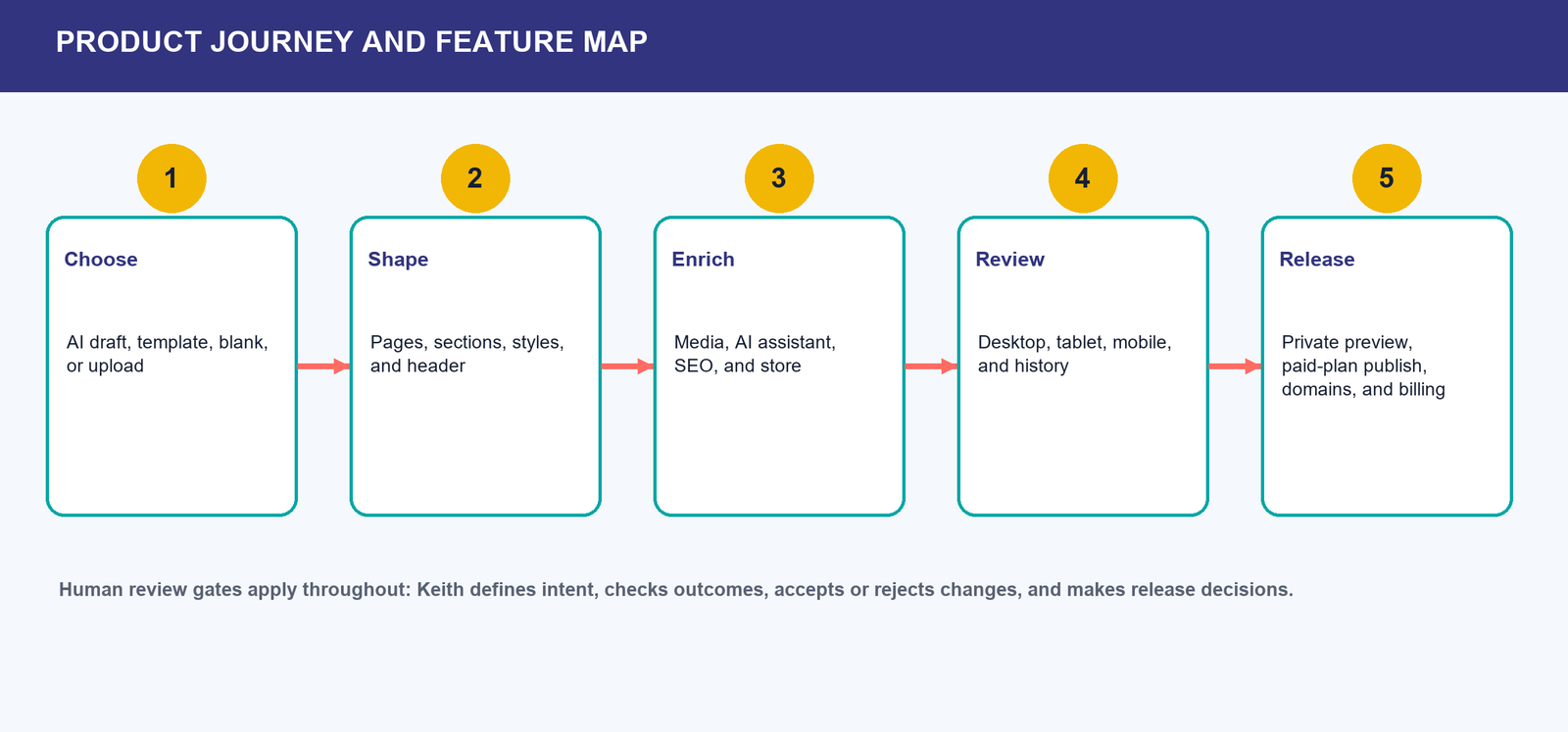
The product had to help customers begin in the way that fit their situation, then bring content, structure, responsive layout, media, search settings, store configuration, revision safety, preview, publishing, domains, and plan limits into one understandable system.
The design challenge was not simply generating pages. It was creating a dependable operating model for a website: enough guidance for a first-time creator, enough control for deliberate editing, and explicit boundaries around what AI, the customer, and the platform each control.
My role
I defined the product intent, operating boundaries, experience structure, visual direction, technical requirements, acceptance criteria, and release decisions. AI accelerated bounded implementation and analysis inside that human-led process.
Four creation paths
Describe the business and direction, then review a generated first draft rather than accepting an opaque final result.
Begin from a structured design pattern and adapt content, styling, pages, sections, and site settings.
Build directly with sections and elements when the structure and visual direction are already understood.
Bring in a validated portable site document while excluding account data, private integrations, and unsafe local references.
The creation paths change how a site begins—not the ownership, tenant, validation, preview, or publishing boundaries that govern it afterward.
Experience the live Website Builder
Explore pages, sections, styles, responsive modes, and safe in-browser editing. The demo is a sanitized representation of one allowlisted site. Changes remain in memory, reset on refresh, and cannot save, publish, upload, use AI credits, submit forms, reach store or account data, or alter the production site.
The outer frame grants scripts and same-origin access only because the editor's responsive canvas uses its own same-origin frame. Top navigation, downloads, forms, popups, storage access, camera, microphone, geolocation, clipboard, and other capabilities are not granted.
Visual editor and tooling
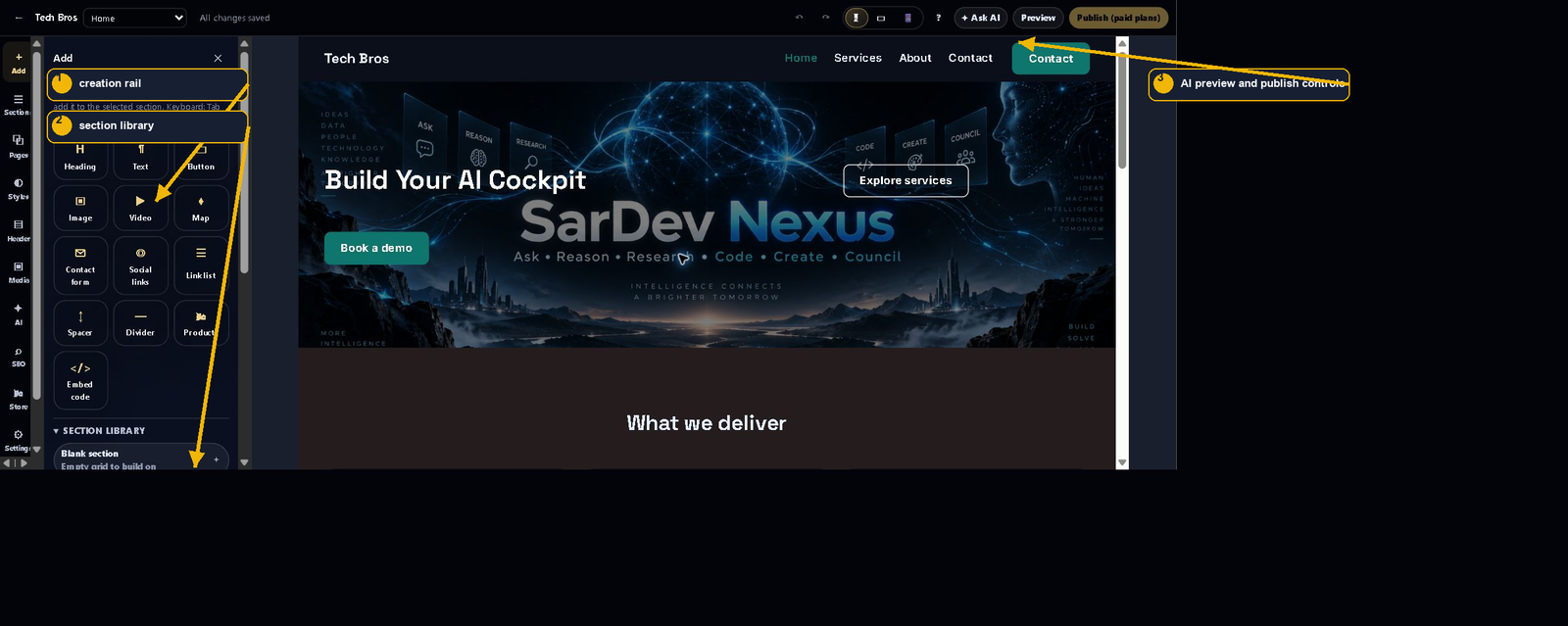
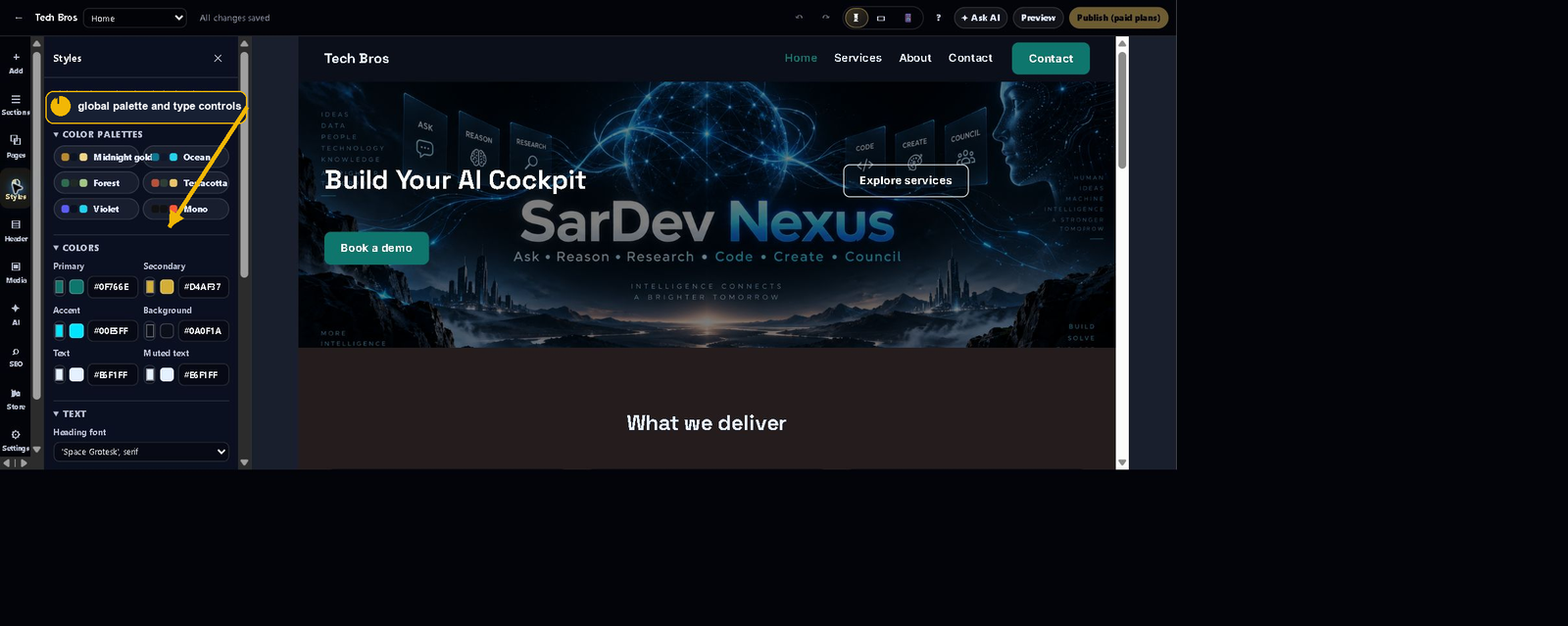
Website-level tasks, page structure, section order, element settings, and global style choices occupy distinct but connected layers.
Selection, inline text editing, reordering, resizing, duplication, deletion, and contextual inspection support visible cause and effect.
Desktop, tablet, and mobile modes let creators review layout intent without losing the shared site document.
Autosave, optimistic concurrency, browser undo/redo, recovery drafts, revision history, restore, preview, and rollback serve different recovery moments.
Architecture and deployment model
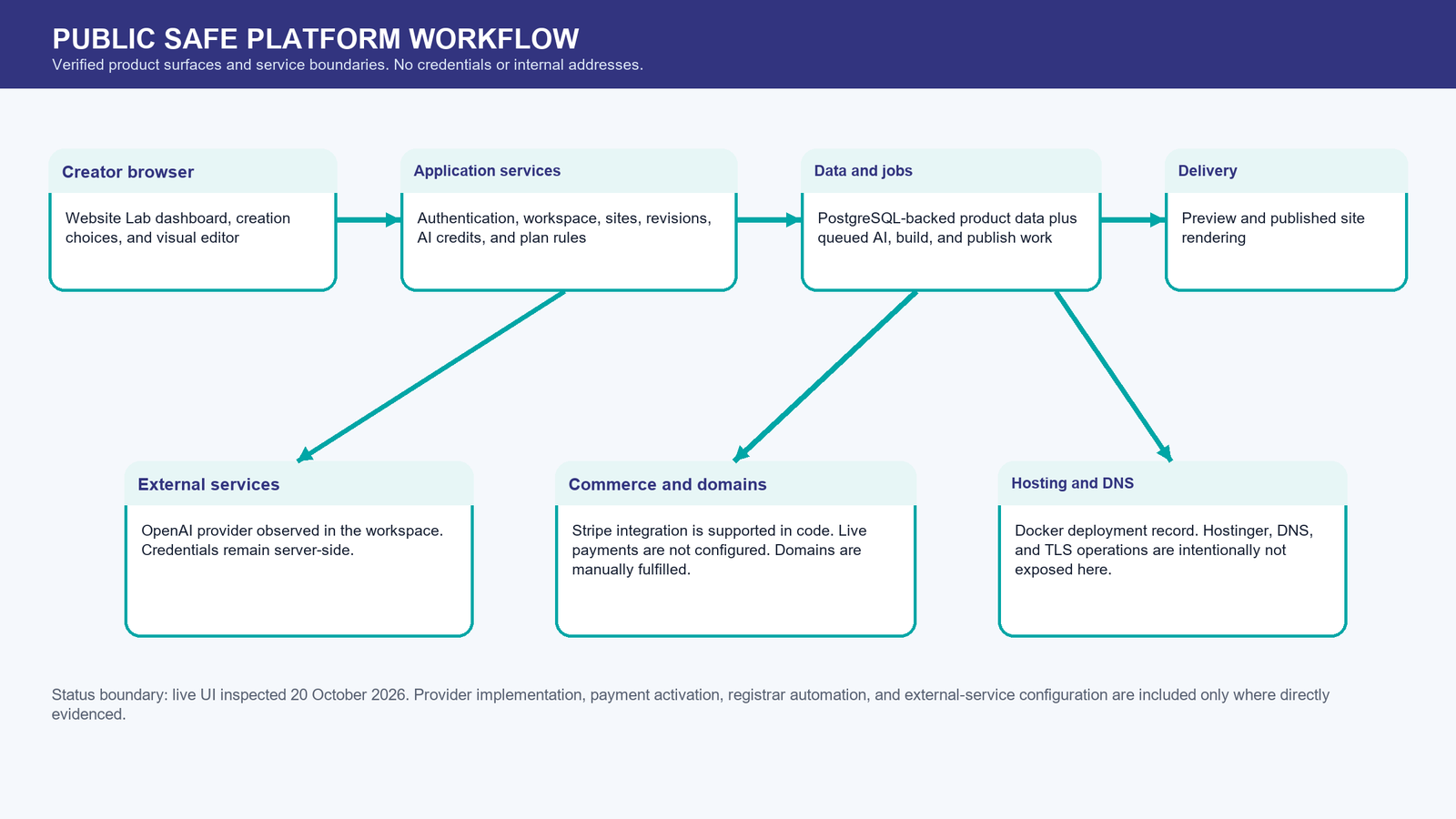
React 19, Vite 8, a validated site-document model, reusable renderer, responsive editor canvas, and keyboard-aware controls.
Fastify 5 routes for authentication, tenant-scoped sites, assets, revisions, preview, publishing, forms, domains, billing, stores, support, and administration.
PostgreSQL 16 records site revisions and tenant data; queued jobs isolate longer-running AI, preview, publishing, domain, and operational work.
Separate platform, worker, and site-serving processes run in Docker behind Caddy, with health checks, persisted data volumes, backup procedures, and rollback records.
QA and evidence
The supplied report records 68 passing Vitest checks across unit and integration coverage at its October 2026 evidence point.
The report records 14 passing Playwright tests covering core journeys and public behavior at that same evidence point.
Desktop, tablet, and mobile controls expose distinct layout review states inside the shared editor.
Only one site ID has a sanitized anonymous data path; mutation, tenant, account, commerce, AI, asset, form, history, domain, and publish routes remain protected.
Historical counts are attributed to the supplied report and are not presented as newly run checks. Current deployment verification is documented separately from that report snapshot.
Current boundaries
The platform, authenticated owner editor, sanitized portfolio demo, core public pages, and production health endpoints are checked against their live URLs after release.
The 31-page report documents prior design decisions, source inspection, QA records, and the state observed when the report was prepared.
Publishing, AI credits, custom domains, custom code, store operations, and other capabilities remain governed by account permissions, plan rules, and production configuration.
No user count, adoption, conversion, revenue, ROI, retention, customer-satisfaction, independent accessibility certification, compliance certification, live-payment outcome, or automated domain-fulfillment claim is made.
Domain work was human-mediated rather than fully automated, production payment behavior was not established, and the historical QA record was not an independent accessibility or security certification. The portfolio demo intentionally removes persistence and every network-backed account feature.
Lessons
Key insight
A coherent platform still requires a person to understand the customer, define the system, set security and evidence boundaries, review generated work, reject weak assumptions, protect working behavior, and decide what is ready to release.
I supplied that product authority. AI supported bounded execution.Explore the evidence
The report is published exactly as supplied. The live demo is intentionally narrower than an authenticated owner editor and cannot change the source site.